


TL;DR:
We backed up 12 months of English Wikipedia (
enwiki) dumps into a single Kloset store. The final snapshots represented around 1.35 TB of logical data, while the repository itself only occupied 463 GB on disk.
At Plakar, we like to experiment on projects for the sake of technical fun.
Wikipedia publishes public dumps of its data, making it possible to preserve independent copies of the encyclopedia.
For this experiment, we used the monthly English Wikipedia (enwiki) dumps.
Each dump is distributed as one large XML file representing the state of the
encyclopedia at that point in time. Once uncompressed, each monthly dump is
around 110 GB.
That makes it an interesting dataset for testing deduplication. Every monthly release is another full copy of the encyclopedia, but most of the content stays the same between releases.
The question was simple: How well can Plakar store 12 monthly Wikipedia dumps?
The problem with traditional backups
The obvious approach is to store every monthly dump separately.
That works, but it gets expensive quickly. Twelve monthly dumps at roughly 110 GB each already means well over a terabyte of data.
The bigger issue is repetition. The February dump is not a patch on top of the January dump. It is another complete XML file. The March dump is another complete XML file again.
So if a backup system treats the file as one big object, it ends up storing almost the same encyclopedia over and over again.
That is exactly the kind of workload where deduplication matters.
Why Plakar is a good candidate
Plakar is built around a content-addressed store. Instead of storing the same data repeatedly, it stores unique pieces of data once and lets snapshots refer back to them.
To understand why that matters, imagine a 10 MB file and two versions of it.
The naive approach
The simplest strategy is straightforward: if the file is not already present in the store, save it.
That is very easy to implement, but it has a major limitation. If the file changes, even slightly, the whole file becomes invalidated and has to be stored again.
For Wikipedia dumps, this would work very poorly because each monthly dump is one massive XML file.
Fixed-size chunking
A smarter approach is to split the file into fixed-size chunks, for example 1 MB chunks.
Now the backup system can check each chunk independently. If a chunk already exists in the store, there is no need to store it again.
This already works much better. If data is appended at the end of the file, only the new chunks need to be stored.
But fixed-size chunking still has a weakness.
If data changes near the beginning or middle of the file, all following chunk boundaries shift. Once that happens, many chunks no longer line up with the previous version, even if most of the content is still identical.
So the backup system ends up storing a lot of data again simply because the fixed chunk boundaries moved.
Content-defined chunking
Plakar uses content-defined chunking (CDC).
Instead of cutting chunks at fixed offsets, CDC derives chunk boundaries from the file content itself.
That makes the chunking resistant to insertions and modifications in the middle or beginning of a file. Changed areas produce new chunks, but unchanged areas around them can still be recognized and reused.
This makes CDC a very good fit for large evolving files like the Wikipedia dumps.
Each monthly dump is still one huge XML file, but Plakar can recognize repeated content inside the file and avoid storing it again.
CDC is more complex internally, but the Plakar team already did the hard work and made this possible.
If you want a deeper technical explanation of how CDC works internally, check out the dedicated CDC blog post.
The setup
We downloaded 12 monthly enwiki dumps and backed them up into a single Kloset
store.
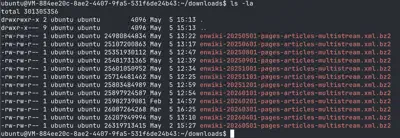
Each month was stored as a separate snapshot. The source directory kept growing over time: first one dump, then two dumps, then three, until the final snapshot contained all 12 monthly dumps.
The backups were run on a cloud instance with 4 vCPUs and 16 GB of RAM. On average, each backup took around 21 minutes to complete.
The first backup processed 109 GB of logical data and stored 45.1 GB inside the repository.

After all 12 dumps were backed up, the latest snapshot represented around 1.35 TB of logical data.
The entire repository only occupied 463 GB on disk.
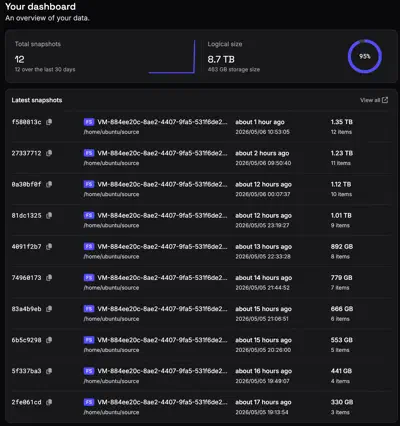
That means Plakar was able to preserve all 12 monthly snapshots while storing roughly one third of the original data size.
Conclusion and next steps
The goal of this investigation was simple: see how Plakar performs when backing up multiple months of Wikipedia dumps.
For this first test, we backed up the dumps exactly as they are published: one large XML file per month. Even then, the storage reduction was significant.
There is still an interesting next step though.
Instead of backing up one massive XML file, we could split the dump into individual Wikipedia pages and back those up as separate files. That would make the dataset much easier to browse in Plakar UI, since every page could appear as its own file instead of being buried inside a huge XML document.

That could make for a fun community project to build a Wikipedia importer for Plakar.
A Plakar integration is relatively easy to build, and the integration example repo is a good place to start if you want to experiment with one.